 中文
中文
What is a gear?
It is a wheel-shaped mechanical part that relies on the meshing of the teeth to transmit torque. The gear is driven by other toothed mechanical parts (such as another gear, rack, worm), which can change the speed and torque, change the direction of movement and change the form of movement. Due to the advantages of high transmission efficiency, accurate transmission ratio and large power range, gear mechanism is widely used in industrial products. The teeth of the gears interlock with each other and the gears turn the other gear to transmit power. To separate the two gears, a chain, track, and belt can also be used to drive the gears on both sides and transmit power.
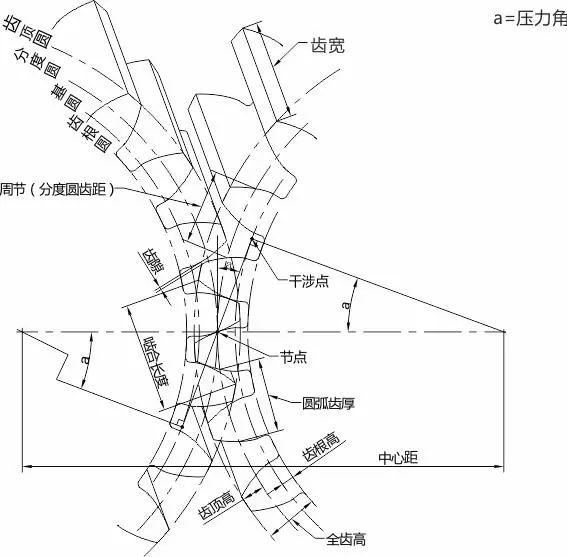
Gear total points name
Precautions for use
① Confirm whether the gear is installed in place before starting.
The contact of the gear can not be biased to one end.
③ Avoid use without backlash.
④ Proper lubrication.
⑤ If the gear is exposed, please be sure to install a protective cover to ensure safety.
⑥ Do not touch the gear while it is rotating.
⑦ When there is abnormal noise and vibration during operation, please stop to confirm gear meshing and assembly.
What is a rack?
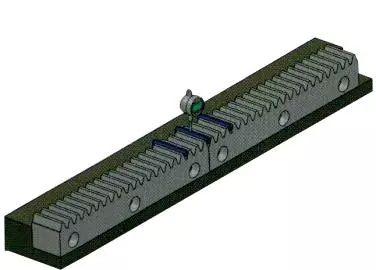
The tooth profile of the rack is a straight line rather than an involute line (it is a plane for the tooth surface), which is equivalent to a cylindrical gear with an infinite index circle radius. It is divided into straight rack and helical rack, which are used with straight gear and helical gear respectively.
Rack assembly instructions
Rack can be butt mounted to any length. During assembly, the gap between the two racks should be adjusted to match the tooth spacing. Use positioning pins to install the rack.
Step 1: Locate and secure the rack.
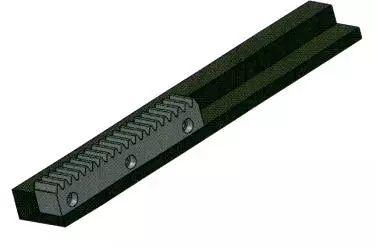
Step 2: Use reverse gear gauge to position the next rack.
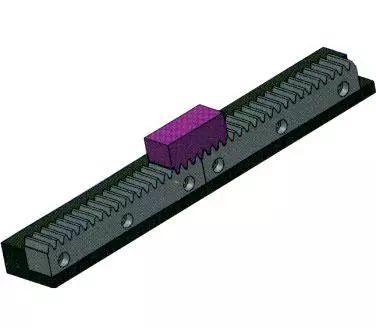
Step 3: Check each interface one by one, and use a round rod to detect the parallelism of the rack.